Folder 409: Part 3: The Vault Door
"If you're hearing this recording, Elias... you've already lost."
Loading...



Suggested:
Mr. Jamiu Ajanlekoko, a hardworking Nigerian hustler, sacrificed everything to finance Ronke’s university education and master’s program in London....
This is a story of sacrifice, betrayal, and the harsh lessons of unintended consequences.
The smell of Akure at 5:00 AM was always a mix of damp earth and the first smoke from the roadside tea sellers. For Jamiu Ajanlekoko, it was the smell of opportunity. At 23, Jamiu didn't look like much—his shirt was faded, his palms were rough from labor, and he always seemed to be running. But his eyes held an incandescent hunger.
He was a "hustler" in the truest Nigerian sense. He had four different businesses: he managed a small car wash by day, ran a reliable delivery service on his worn-out Okada by evening, and negotiated subtle, shrewd real estate deals on weekends. "Mr. Jamiu," the market women called him, a title earned by his fierce reliability. He wasn't working to buy gold chains or a new Lexus. He was working for a dream named Ronke.
He met Ronke when she was 17, selling bottled water at the motor park. She was soft-spoken, but she possessed a brilliance that radiated even while shouting the prices of cold water. Jamiu saw it instantly. He fell in love not just with her laugh, but with her raw potential.
"You are going to be a lawyer, Ronke," Jamiu would tell her, handing over a stack of naira notes at the end of every month. He didn't just support her; he assumed her success. He paid her JAMB fees. He paid for her pre-degree program. While his peers spent their earnings on frivolous pleasures, Jamiu wore the same two pairs of shoes so Ronke could buy law textbooks. He poured his life into hers.
When she gained admission to the University of Ibadan, Jamiu celebrated more than she did. He upgraded his hustles. The motorcycle was swapped for a second-hand Corolla, allowing him to drive long distances for more lucrative gigs. Every kobo that wasn't for essential food went to Ibadan.
Four years passed in a blur of long-distance calls and infrequent weekends. Jamiu was a pillar. When the union went on strike and schools closed, he paid for her travel home. When she needed a new laptop, he skipped meals to ensure she had the best.
Then, the ultimate dream surfaced during her final year. Her department was organizing a master’s scholarship program in London, with potential for long-term work placement. It was a golden ticket. The scholarship covered tuition, but the logistical costs—visa fees, embassy travel, insurance, the immense proof of funds, the initial ticket—were monolithic.
Jamiu sat in his small, hot one-room apartment, looking at the figure on the spreadsheet. It was almost everything he had saved from four grueling years. Selling his car would get him the rest.
"Jamiu, you can't sell your business," Ronke said over the phone, her voice thick with hesitation, but also a sliver of desperate hope.
"I am not selling my business, Ronke. I am selling the car," Jamiu said softly. "Cars are objects. You are my future."
Within a week, the car was sold. The money was wired. He stood with her at the airport, watching her walk through the boarding gate. She was wearing a new jacket he’d bought her. As she turned to wave, he didn’t see a woman moving away; he saw his crowning achievement. His life’s investment, in human form.
The letters and calls were regular at first. *London is cold, Jamiu. But the libraries are magnificent.* She sounded like the lawyer he always knew she would be. Jamiu went back to his Okada, working harder than ever to build a life for when she returned, or for when he could join her.
The distance, however, began to stretch not just across geography, but through silence. The calls became rushed. The emails, once paragraphs, became sentences. When she graduated with a distinction, he only found out from her Facebook post, where she thanked her family and "all those who believed in me." He was just "all those."
The crushing blow came three months later. A letter postmarked from Lagos.
Jamiu, sitting on a stoop at the car wash, his hands still covered in soap suds, tore it open. It was a formal, typeset letter. It was the hardest thing she would ever have to say, she wrote. He was the kindest man she knew, and her debt to him was infinite. But London had opened her eyes. She had met someone else. He was older, established, already living in England, a consultant. His name was Femi.
"Jamiu, love isn't always fair," she wrote. "We are walking different paths now. Please, do not hate me. I will repay every kobo, I promise."
He didn’t read the promise. He stopped at *We are walking different paths now.* The sun beat down on Akure, but for Jamiu, the entire world had frozen. He didn't cry. He just felt an immense, physical hollowness, as if his internal organs had been turned into dust.
He had built a shrine to her, and she had taken the gold and left the mud for him to sleep in.
For two years, Jamiu existed as a ghost. He still worked, but the hunger was gone. He was no longer Mr. Jamiu, the ambitious. He was just Jamiu, the man who was used.
Three years later, Jamiu, having slowly rebuilt his small taxi fleet and married a quiet, loyal woman from his church, was at the passport office in Lagos, processing an application for his wife.
The office was chaotic and overcrowded. He was waiting when a movement caught his eye near the entrance.
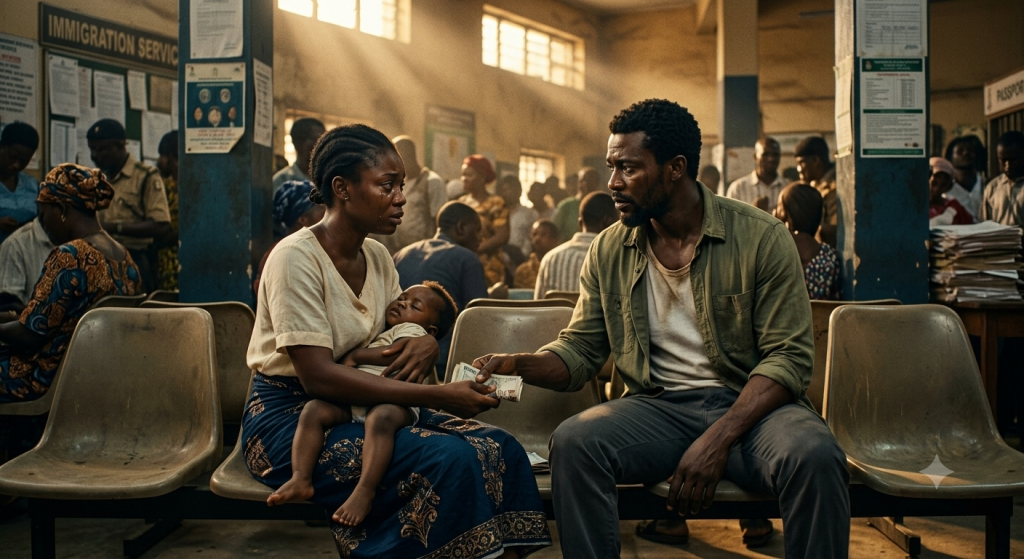
A woman was sitting on a plastic chair, her head low, cradling a toddler. She looked defeated, the vibrancy of life completely drained. It was Ronke.
He didn’t call her name. He walked over slowly and stood until she raised her eyes. When she saw him, her initial shock vanished into a deep, agonizing flush. "Jamiu," she whispered, her voice a fragile reed.
He looked at her. Her face, once bright with potential, was etched with worry. She wasn't the powerful lawyer she was supposed to be. She was dressed simply, the fabric of her skirt worn. The magnificent London life was nowhere to be found.
"Ronke," he said, and for the first time in years, the hallowed title felt right. He sat in the empty chair beside her.
They were silent for a long time. The cries of the children and the shouts of the immigration officers surrounded them. Finally, she broke the silence, her words pouring out like a broken dam.
Femi was a phantom, she told him. He was charming and successful, yes, but also a pathological liar. The big, magnificent London life was a small house they shared, financed almost entirely by his "consultancy" fees that never seemed to cover the bills. She had spent two years fighting for jobs, barely surviving. Femi had forbidden her to practice law until she was "settled," but the settling never came.
"And then I found out," she said, her voice dropping to a whisper. "The consultancy work... the frequent travel... it was all lies."
She looked away, fresh tears welling up. "One week after I had our son, a woman came to our house in London. A woman from Nigeria. A woman named Dupe. With three children."
Ronke’s entire body was shaking. "Jamiu... Femi is not a consultant. He runs a logistics business in Apapa, and he has a wife in Lagos. He has another wife, Funke, in Ibadan. And he has five kids between them, before my son."
She squeezed her eyes shut. "He never lived in London. He just maintained an apartment there to house his 'projects.' Me. He met me at a legal conference and decided I was his new 'London project.' I was just his secret, his sophisticated mistress, his foreign status symbol."
Jamiu listened, the information hitting him not with jealousy, but with a complex, aching sadness.
"When Dupe exposed everything," Ronke continued, her hand trembling as she stroked the toddler’s head, "he didn't apologize. He just said he couldn't afford to maintain us anymore. He cut my funding. He canceled my apartment lease. I came back to Lagos, Jamiu... to live with my sister in a two-room shack. I’m here applying for a travel ban to stop him from taking my son to his village in the north."
She finally looked at him, her eyes raw with shame.
"The repayments I promised... the path I thought I was walking... it was all a mirage. I used you, Jamiu. I used your life, and I wasted my own. Now I am nothing."
He didn't know what to say. The anger was gone, but the love was also a distant memory. He looked at the girl he had poured his soul into, the brilliance he had worshipped. He saw a woman who had let the promise of comfort destroy the foundation of character.
Finally, he spoke, his voice gentle but firm. "No path is wasted if you learn from it, Ronke. You are not nothing." He looked at the child. "You have him."
He reached into his pocket and pulled out a stack of naira notes—a habit that had never left him—and gently placed them into the hand that had once held all his hopes.
"For your son," he said.
"Jamiu, no. I can't..." she started, her tears flowing freely now.
He stood up, adjusting his shirt. "Do you remember the first thing I ever told you? 'You are going to be a lawyer, Ronke.' Go and finish your degree, Ronke. Be the lawyer you were meant to be. Don't waste the person you are."
He didn't wait for her reply. He walked away, not looking back, toward his own life and his own path.
For Ronke, watching his retreating figure, the memory of his kindness was an anchor in the storm of her despair. For Jamiu, the sight of her wasn't a painful echo, but a final, somber closure. His investment had truly been lost, but as he left the passport office and walked into the bright, harsh Lagos sun, he realized that for the first time in his life, he was not the only one who was paying for the mistakes.

"If you're hearing this recording, Elias... you've already lost."
The ink on the PS5 Pro reviews is barely dry, but in the fast-paced world of gaming, the tech community is already looking over the horizon. Rumors, supply chain whispers, and hardware leaks regarding Sony’s next-generation PlayStation 6 have been running rampant.
A voice rasped from the burner phone's speaker. "You were supposed to panic."